

While it has always been one of the classic monsters in horror, the werewolf has long lingered in the shadows, eclipsed by Dracula and Frankenstein’s Monster. The Hammer Horror movies only made one werewolf movie while, at Universal, it took several Dracula and Frankenstein films before they got around to making werewolf movies.
These lycanthropes may not have the literary background of Stoker’s Count Dracula, or Shelley’s Monster, their origin goes back much further than Victorian literature. Right back to the rich and strange tales in European folklore. Whether it’s a choice, a bite, or a curse, the legends all state that werewolves are humans who change into a savage, murderous wolf on a Full Moon night. And the act of transforming itself can be symbolic — releasing the primal beast hidden in us all and returning civilized man to nature in a more animalistic form.
The appeal in horror filmmaking (and viewing!) when it comes to werewolf movies is not only the visual grossness of the change, but the layers of subtext about what that transformation could mean. So, without further ado, lets fire that silver bullet through ten of the best werewolf movies ever made.
This post contains affiliate links. If you watch a movie we’ve recommended using our links, you’ll be helping to support HorrorFam.com at no additional cost to you!
10. Wolf (1994)

These days, with multiple franchises and movies made by committee, no studio would put $70 million into a movie like Wolf. But back in the 1990’s, spec-scripts were common and star-director packages were still around. And, every now and then, they resulted in something as crazy as this.
Directed by Mike Nichols, Wolf is as eccentric as they come. It’s a supernatural horror romance that’s as much about backstabbing in a corporate publishing house as it is about howling at the moon and spilling blood.

Jack Nicholson as the wolfman is flawless casting. He plays a down on his luck editor who’s bitten by a wolf in Vermont. After this, he morphs into the alpha Nicholson we all know and love. Sweeping Michelle Pfeiffer off her feet and going up against his main rival, James Spader at his sleazy, oiliest best. The rest of the cast is fantastic too, with David Hyde Pierce, Christopher Plummer, and Richard Jenkins as standouts.
The prosthetic, fully transformed wolf scenes look a bit ropey even for the ‘90s, but when it’s just “Jack being Jack” Wolf is an absolute treat.
Where to watch Wolf (1994):







9. The Wolf Man (1941)

Not the first werewolf movie, which can be tracked back to the now lost The Werewolf made in 1913, The Wolf Man is a classic in Universal Studios’ monster collection, and gives us a few of the trademarks that would go on to feature in other werewolf movies.
Larry Talbot (Lon Cheney Jr.) returns to Wales to manage his family’s estate and is attacked by a wolf-like creature. Soon, he’s changing into a wolf and attacking the locals at night, and trying to seduce the antique shop owner (Evelyn Ackers) by day.
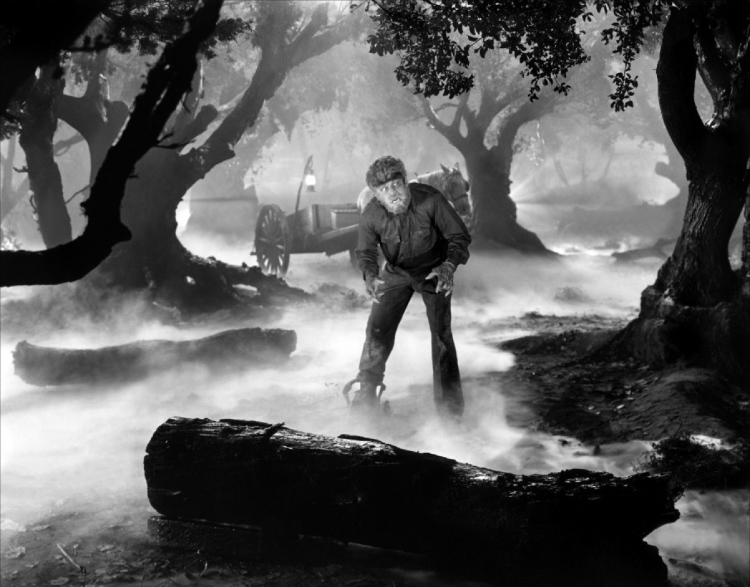
Surviving an attack by a werewolf while pursuing a romantic relationship would become a standard in the werewolf genre. The wolfmen are usually seen as tragic anti-heroes with doomed love lives.
Here, director George Waggner delivers a movie full of atmosphere – all fog and forests, and following the folklore of the werewolf. Anyone who has ever heard the old rhyme “Even a man who is pure in heart and says his prayers by night / May become a wolf when the wolfsbane blooms and the autumn moon is bright,” knows this is where it comes from.
Where to watch The Wolf Man (1941):


8. The Company of Wolves (1984)

When director Neil Jordan makes a horror movie, something amazing is created. Byzantium and Interview with The Vampire are two near-flawless vampire movies; and with the gothic Company of Wolves he adds a werewolf movie to his list of folklore-based horror masterpieces.
There are so many sources of adaption and inspiration Neil Jordan works from here. There are lifts from Charles Perrault’s original Red Riding Hood, which Angela Carter reinterpreted in a short story collection titled The Bloody Chamber, and then reworked for BBC radio. Layer upon layer.

Angela Lansbury plays Granny, who’s telling nightmarish fairy tales to Rosaleen (Sarah Patterson). There’s a dreamlike atmosphere in the film, with Granny’s stories mixing in and out with the main narrative.
Strange and surreal imagery abounds, none more so than the 19th Century banquet filled with boorish and jeering aristocrats who begin to change into wolves at their tables. Company of Wolves is a bizarre and unique movie, and there will probably never be another like it.
Where to watch The Company of Wolves (1984):





7. The Howling (1981)
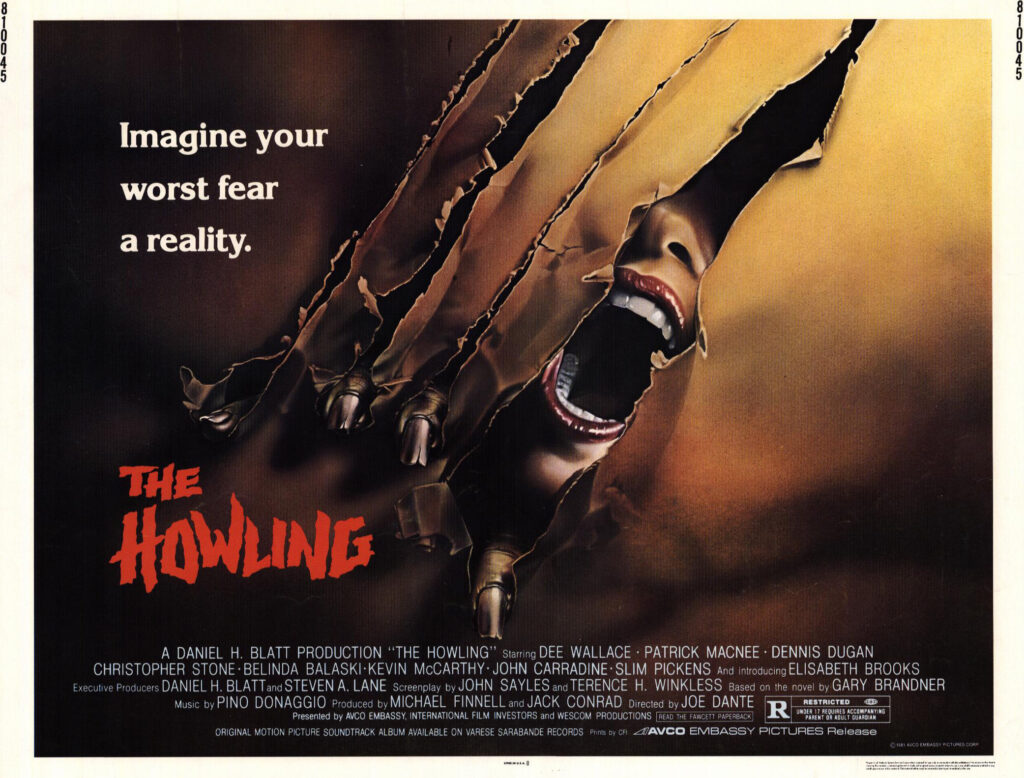
One of four werewolf movies released in 1981 (one more of which will be featured later on this list of great werewolf movies), The Howling is based on the novel of the same name by Gary Brandner.
Dee Wallace stars as Karen White, a journalist sent to a retreat to relax after an encounter with a serial killer. But, of course, the retreat isn’t as relaxing as she would hope.
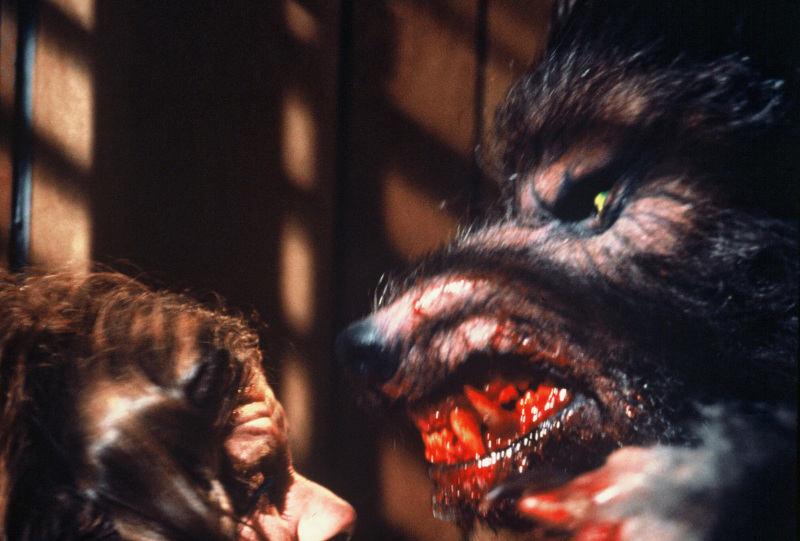
While The Howling is a straight horror movie, it pays homage by naming most of the characters after werewolf movie directors. And the makeup, by the great Rob Bottin, still holds its own. Human faces pulled into wolves’ snouts in all their bloody, skin-stretching glory!
The moments of body horror are matched brilliantly with the script by John Sayles which highlights the connection between transforming and sexual desire that was only hinted at in previous movies. When the characters begin to engage in sex and infidelity, you know a painful transformation is on the way. There are seven sequels of varying quality, but as is usually the case, the original is the best.
Where to watch The Howling (1981):







6. The Curse of the Werewolf (1961)

The Curse of the Werewolf is the only werewolf film produced by Hammer Film Productions, and is unique in its Spanish setting. It begins with an opening that remains brutal and bleak even today. A mute servant girl, played by Yvonne Romain, is raped and becomes pregnant. When Christmas Day comes, she dies in childbirth. The combination of these horrific events curses the child, Leon, to live as a werewolf.
Director Terence Fisher was deliberately pushing against the constraints of the British Board of Film Classification, ultimately losing that fight. Several minutes were cut, only being fully restored in 1992.

Oliver Reed broods intensely throughout the movie as the grown Leon, playing him as a tragic figure struggling internally because of a condition he cannot control. He’s further tormented by his love of Christina (Catherine Feller) and his desire to free himself from his curse.
The Curse of the Werewolf remains a gothic masterpiece, and Oliver Reed gives a brilliant and subtle performance. It’s worth the 45-minute wait before he arrives on screen.
Where to watch The Curse of the Werewolf (1961):
5. Ginger Snaps (2000)

“They Don’t Call It ‘The Curse’ for Nothing” runs the tagline on the poster for John Fawcett’s blackly funny metaphor for puberty, Ginger Snaps.
Loyal sisters Brigette and Ginger (Emily Perkins and Katherine Isabelle) are attacked and bitten by an animal which seems to have been provoked by the onset of Ginger’s menstruation.
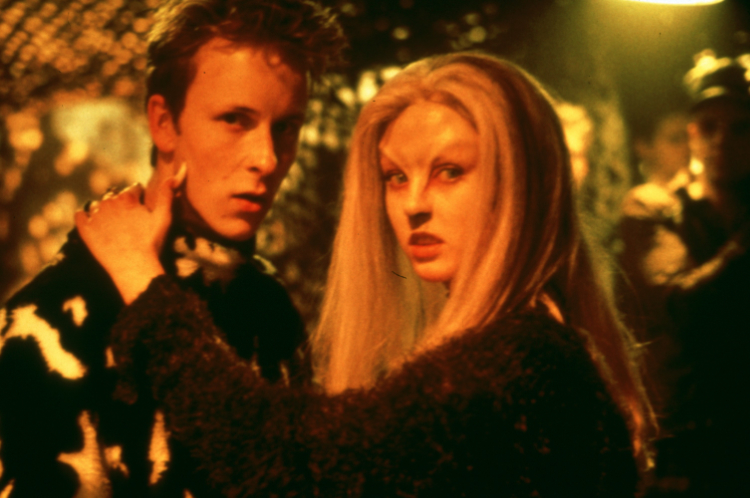
Ginger’s transformation into a werewolf is horrifying, but also empowering, as she makes full use of her new body with sexual pleasure, while taking blood-soaked revenge on those who previously bullied or tormented the sisters. Brigette, on the other hand, is afraid of losing her only friend, as she tries to fix the outcomes of her sister’s violence while trying to find a cure.
Bloody and violent, but with an undercurrent of humor (very much like Heathers), Ginger Snaps remains one of the very few werewolf movies that doesn’t feature a wolf man.
Where to watch Ginger Snaps (2000):
4. Dog Soldiers (2002)

Director Neil Marshall’s debut movie has plenty of shots of the moon filtering through the trees, but Dog Soldiers is less gothic and more pedal-to-the-metal action.
A group of soldiers in the Scottish Highlands are on a training mission against the SAS. They find the enemy dead, and hide out in a cabin against the hordes of werewolves trying to devour them.

Neil Marshall, who also made The Descent along with multiple episodes of Game of Thrones, mixes brutal horror with perfectly timed visual and verbal comedy. The moment when Wells (Sean Pertwee) has to fight off a dog trying to munch on his intestines will stay with you. As will a soldier fighting a werewolf with a frying pan while CCRs “Bad Moon Rising” plays. It’s as horrific as it is humorous.
Director Neil Marshall who also wrote and edited Dog Soldiers, proving that a low budget is no barrier when you’re this imaginative and inventive.
Where to watch Dog Soldiers (2002):



3. When Animals Dream AKA Når dyrene drømmer (2014)

The directorial debut of Jonas Alexander Arnby, When Animals Dream uses soft, muted tones throughout to create a sense of dread and foreboding. And like so many other great werewolf movies, the transformation into the lycanthrope is set alongside the approach of adulthood.
Growing up in a small isolated village, and being bullied at the food processing plant where she works, shy teenager Marie (Sonia Suhl) begins to discover rashes over her body that seem to be sprouting hair.
When Animals Dream reminded me of Oliver Reed in Curse of the Werewolf, in that Sonia Suhl gives a remarkable and sympathetic performance as Marie. She’s trying to cope with the physical and emotional changes of becoming a woman while, at the same time she realizes what she can become, and the power now afforded to her.
Marie’s changes into a werewolf are much like Sonia Suhl’s performance; subtle and understated. Heightened emotions bring on her changes, rather than the moonlight. When Animals Dream is a beautifully made werewolf movie with just enough gore and violence to keep everyone happy.
Where to watch When Animals Dream (2014):
2. Teen Wolf (1985)

In director Rod Daniel’s teen comedy Teen Wolf, the werewolf is again linked to puberty but Daniel’s extends it further to make it about transitioning from childhood to adulthood.
Teenager Scott Howard (Michael J. Fox) begins to notice some unusual changes happening to his body. His ears are becoming more pointed, his teeth are becoming sharper. This culminates with him locking himself in the bathroom while his father hammers on the door (d’ya get it?). When Scott opens the door, he sees his father is also a werewolf, revealing that their family is cursed with lycanthropy.

The practical effects in Teen Wolf still hold up today. Using a series of prosthetic bladder effects, we see bones moving apart, skin start to ripple, nails growing, and hair sprouting everywhere. And, with this, we see the frightening reality that occurs when your body starts to change in your teenage years.
But through all this, Teen Wolf never takes itself too seriously. Instead of rejection, Scott Howard becomes popular, a star basketball player, and gets the pretty girl, all while experiencing all the trials and tribulations of teenage life. Michael J. Fox uses all the innocence and appeal he has to play Scott, which leaves Teen Wolf as an unusual portrayal of a werewolf that makes its title character relatable and sympathetic.
Where to watch Teen Wolf (1985):

1. An American Werewolf in London (1981)

Before directing this, John Landis was known for comedies — Blues Brothers, Animal House, The Kentucky Fried Movie,etc. And there are laughs in An American Werewolf in London, but it’s overall a much deeper experience.
David and Jack (David Naughton and Griffin Dunne) are attacked by a monstrous wolf while walking on the Yorkshire moors. Jack is killed and David badly mauled. Waking in the hospital, David is visited by the undead spirit of Jack who cheerfully informs him they were attacked by a werewolf and David must kill himself before the next full moon. If he doesn’t, he too will change.
The flawless transformation scene, set in a regular living room under bright lights, can’t be topped. Makeup artist Rick Baker won an Oscar for the painful, physical mutation. Bones are broken and moved, skin is stretched, and David screams throughout it all. As director John Landis stated: “If your body is gonna go through such a huge change, it’s gonna HURT.” And, thus, David’s blood-soaked rampage through London begins.
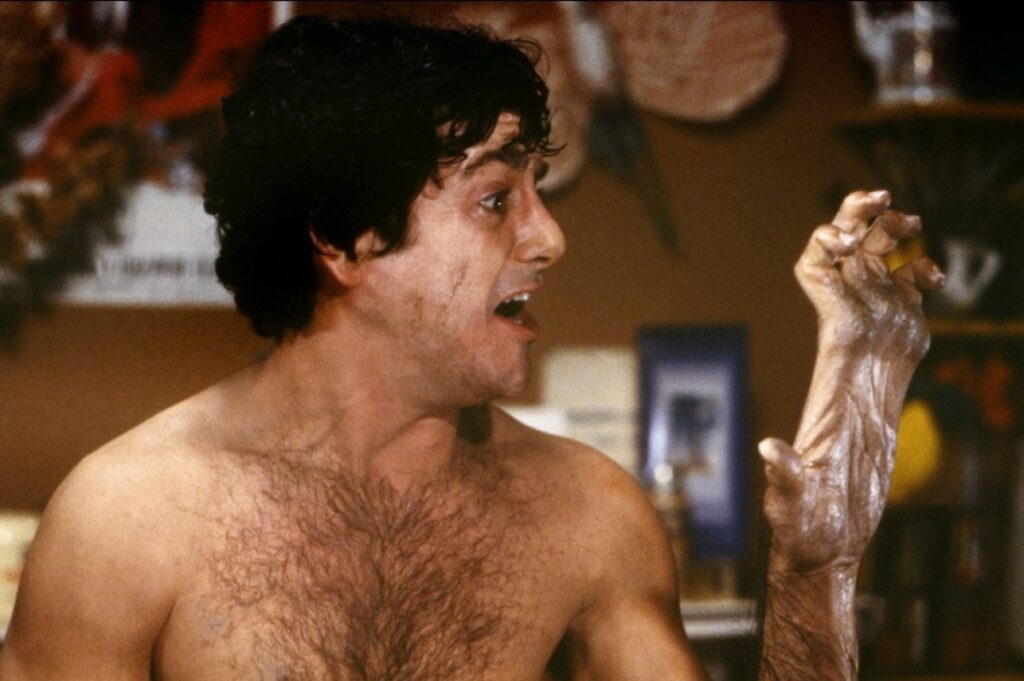
An American Werewolf in London is a love letter to previous great werewolf movies but also stands alone. The scares are more frightening, the sex is more explicit, and the soundtrack filled with moon-based songs can’t be beaten. It’s a story about friendship and doomed love [with Nurse Alex Price (Jenny Augutter)]. But it also has a group of recently-killed zombie-esque victims sitting in a porn cinema urging David to kill himself, and Jack complaining “Have you ever talked to a corpse? It’s boring.”
As a movie, An American Werewolf in London shouldn’t work, but it does. It’s scary, funny, and sad. This isn’t just a fantastic werewolf movie; it’s also just a great movie overall.
Where to watch An American Werewolf in London (1981):



What are YOUR favorite werewolf movies?
As a genre, werewolf movies are always evolving. As moviemakers find new ways to explore the themes of transformation, identity, and the beast we all have within us. The lycanthrope is still one of cinema’s most enduring monsters, whether it’s a full-on horror, a drama, a comedy, or even an art-house experimental.
Each of the werewolf movies on this list show the range of werewolf cinema, from the classic monsters of Universal to modern psychological horror. They’re all unique and bring the primal thrills that make werewolf movies so compelling. So, what are YOUR favorites…?
*** This article was written by Adam Page. Learn more about him in his author bio below***
Editor’s Note: For anyone who was wondering, the other two werewolf films released in 1981 (besides The Howling and An American Werewolf in London) were Wolfen and Full Moon High. -L*
Images for this post were purchased via CineMaterial and MovieStillsDB and used for review purposes.

I love that WOLF makes this list. I just watched it again for the first time in *years* a month or two ago and the friends I was with were just appalled by how terrible it was (and I’m not saying they’re wrong, but…they’re wrong). I’ll never understand why they decided to sink so much money into that movie, but if that’s what it takes to get Jack Nicholson pissing on James Spader’s shoes—I’ll take it every time!
Interesting list. I think The Wolfman, in addition to what’s said in the article, deals with a rare theme: the effect of patriarchy on the male child. Larry Talbot struggles from beginning to end to be accepted by his father and, ultimately, is destroyed by him. I watched The Company of Wolves in an old cinema with a huge screen, and aesthetically this film is a triumph, a beautiful and captivating bloody fairy tale. Although I love An American Werewolf in London, at the time The Howling impressed and terrified me much more. The transformation scene with Pino Donagio’s soundtrack is unforgettable. As a side note, it’s worth mentioning that The Howling II – Your Sister Is a Werewolf is also unforgettable, but for the wrong reasons. But I also rewatch it whenever I can, and Steve Parsons’ song Howling never leaves my playlist.